Growth hormone does three things that matter for bodybuilding: it stimulates muscle protein synthesis, accelerates tissue recovery, and shifts body composition toward lean mass. But the details matter — and the gap between what HGH can do and what supplement companies claim it does is significant.
What HGH Actually Does
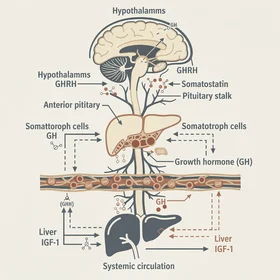
Human growth hormone is a 191-amino acid peptide produced by the anterior pituitary gland. Its effects on fitness-relevant functions include:
- Muscle protein synthesis: HGH stimulates IGF-1 (insulin-like growth factor 1) production in the liver, which in turn promotes protein synthesis in muscle tissue. This is the primary mechanism by which HGH supports muscle growth.
- Lipolysis: HGH promotes fat breakdown, particularly visceral fat. Higher HGH levels are associated with improved body composition — more lean mass relative to fat mass.
- Recovery: HGH accelerates tissue repair, collagen synthesis, and bone density. This translates to faster recovery between training sessions and reduced injury risk.
- Sleep quality: HGH and sleep have a bidirectional relationship — deep sleep triggers HGH release, and adequate HGH supports sleep quality.
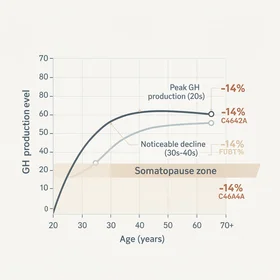
HGH Production Over Time
This age-related decline — sometimes called somatopause — is why men over 30 often notice changes in recovery time, body composition, and muscle maintenance despite consistent training. It's also why HGH optimization becomes increasingly relevant with age.
Natural HGH Optimization
Before considering any supplement or treatment, these lifestyle factors have the biggest impact on natural HGH production:
- Sleep: 70% of daily HGH is released during deep sleep (stages 3–4). Poor sleep directly suppresses HGH output. 7–9 hours of quality sleep is the single most impactful HGH optimization strategy.
- High-intensity exercise: Compound movements and HIIT produce the largest exercise-induced HGH spikes. Volume and intensity both matter — moderate cardio produces minimal GH response.
- Body composition: Higher body fat (especially visceral fat) is associated with lower HGH levels. Reducing body fat can increase natural GH output.
- Fasting: Short-term fasting (16–24 hours) significantly increases HGH secretion — up to 5x according to some studies. Intermittent fasting may support baseline GH levels.
- Minimize sugar spikes: Insulin and HGH have an inverse relationship. High blood sugar suppresses GH release.
HGH Secretagogues
An HGH secretagogue is a compound that stimulates your body's own production of growth hormone — as opposed to injectable synthetic HGH (somatropin), which replaces natural production entirely.
Secretagogues work by providing the amino acid building blocks and signaling compounds that trigger pituitary GH release. Products like Sytropin use this approach — delivering a blend of amino acids (L-arginine, L-glutamine, GABA, Alpha GPC) and growth factors via oral spray to support natural HGH production. For an independent breakdown of Sytropin's formula, see detailed Sytropin analysis.
The advantage of the secretagogue approach: you're working with your body's own regulatory systems rather than overriding them. The pituitary still controls the feedback loop, which means the risks associated with exogenous HGH (joint pain, insulin resistance, organ growth) don't apply in the same way.
What HGH Won't Do
Honest expectations matter:
- Natural HGH optimization won't produce the extreme results seen with pharmaceutical-dose injectable HGH
- No OTC supplement will raise your HGH to levels comparable to synthetic injection
- HGH support is best understood as one piece of a comprehensive fitness and recovery strategy — not a magic bullet
- Claims about "500% HGH increase" from supplements are typically based on transient amino acid-induced GH spikes, not sustained elevation
Alternatives to Sytropin for HGH Support
Sytropin is one option for HGH support, but it is not the only approach. Here are the main alternatives to consider — each with distinct trade-offs in potency, cost, convenience, and safety.
Other OTC Amino Acid Stacks
Instead of Sytropin, you could use standalone amino acid supplements — L-Arginine, L-Glutamine, and GABA purchased individually. This is a lower-cost alternative that lets you control dosing, but you lose the sublingual delivery advantage and the convenience of a single product. Products like GenF20 Plus and HyperGH 14x are similar OTC secretagogues delivered primarily as capsules. See our product comparison for a side-by-side breakdown.
Prescription Peptide Therapy
For men who want measurable, clinically monitored GH elevation, prescription peptides are the most potent alternative to OTC secretagogues. Sermorelin (a GHRH analog) and Ipamorelin + CJC-1295 (a popular clinical stack) stimulate the pituitary at pharmaceutical-grade potency. These require a doctor's prescription, subcutaneous injection, regular blood work, and cost $200–500+/month — but they deliver dose-dependent, verifiable GH elevation that OTC products cannot match.
Lifestyle-Only Approach
Another option is skipping supplements entirely and focusing exclusively on natural HGH optimization — sleep quality, heavy compound training, intermittent fasting, and stress management. This is the zero-cost alternative and should always be the foundation regardless of which other option you pursue. For men under 35 with healthy pituitary function, lifestyle optimization alone may be sufficient.
Injectable HGH (Somatropin)
Prescription synthetic HGH is the most potent option available — and the most expensive and risky. Injectable somatropin costs $800–2,000+/month, requires physician monitoring, and carries side effects including joint pain, insulin resistance, and potential organ growth at supraphysiological doses. This is a medical intervention for diagnosed GH deficiency, not a fitness supplement. It is not a casual alternative to OTC products.
Bottom line: The right choice depends on your goals, budget, and how aggressively you want to pursue GH optimization. Most men benefit from starting with lifestyle fundamentals, adding an OTC secretagogue if they want additional support, and considering prescription options only if blood work shows clinical need. Check our FAQ for more on how these approaches compare.
Cons & Considerations: Limitations and Safety
Honest disclosure matters. Whether you're considering natural optimization, OTC secretagogues, or prescription peptide therapy, every approach to HGH has limitations and potential side effects you should understand before starting.
Limitations of Natural HGH Optimization
- Modest magnitude: Lifestyle changes (sleep, fasting, HIIT) can increase GH pulses meaningfully, but the absolute increase is modest compared to pharmaceutical intervention. Don't expect a natural protocol to replicate the effects of prescription HGH.
- Difficult to measure: Serum GH fluctuates throughout the day in pulsatile bursts. You can't easily confirm whether your natural optimization is working without repeated blood draws for IGF-1 — which most people won't do.
- Diminishing returns with age: As pituitary capacity declines past age 50-60, natural optimization strategies yield progressively smaller returns (Veldhuis et al., J Clin Endocrinol Metab, 2005).
Side Effects and Safety of Exogenous HGH
These apply to prescription injectable HGH, not OTC secretagogues — but it's important to understand the distinction:
- Joint pain and fluid retention: The most common side effect of supraphysiological GH doses. Carpal tunnel syndrome is reported in up to 24% of adult GH replacement patients (Hoffman et al., J Clin Endocrinol Metab, 2004).
- Insulin resistance: GH and insulin have an antagonistic relationship. Chronic exogenous HGH use can impair glucose metabolism — a caution particularly relevant for individuals with pre-diabetic markers.
- Potential organ growth: Long-term supraphysiological GH can stimulate organ and connective tissue growth (acromegaly-like effects). This is a safety concern with chronic high-dose use, not with natural optimization.
OTC Secretagogue Cautions
- Amino acid sensitivity: High-dose L-Arginine can cause GI discomfort in some individuals. Start with the recommended dose and assess tolerance.
- Drug interactions: GABA and Alpha GPC may interact with sedatives, blood pressure medications, or anticonvulsants. Consult a healthcare provider if you take prescription medications.
- Not a substitute for medical care: If you suspect a genuine growth hormone deficiency (childhood-onset short stature, pituitary injury, radiation history), consult a doctor — OTC products are not appropriate for clinical GH deficiency.
Bottom line: Natural HGH optimization and OTC secretagogues have a favorable safety profile when used as directed. The serious side effects documented in clinical literature are associated with high-dose injectable HGH, not with the secretagogue approach. Regardless of which path you choose, consult a healthcare provider before starting any new supplement regimen — especially if you have existing health conditions.